
Seeing Indians by Judy Helfand
TV entered my family around 1952 when I was seven. Our parents limited my sister and me to watching only a few shows per week, so we had to choose carefully. I always wanted to watch the Westerns. The big draw was the horses. From those shows, and probably mainstream images in children’s books and advertising, I absorbed my notion of “Indians.” “Indians” were so different from the white people that I couldn’t see them as part of my current world. They existed only in the past and on TV. Later I learned about Southwest tribes as my parents loved to travel to Santa Fe and came back with pottery and souvenirs for us kids. Later still I learned of Indians on the East coast greeting the Pilgrims and all that manicured history. By the end of high school, I had learned that people first came to North America across the Bering Straights about 10 million years ago and spread out across all the Americas. So that is what I knew of the Indigenous peoples of the land I inhabited as I entered adulthood. Not much and inaccurate at best; otherwise, outright fabrications.
Over time, my reading and life experiences reshaped, corrected, and expanded my knowledge of Indigenous history of the Americas. Then a few years ago I decided to learn whose land I lived on, how it had come to me. What role did my ancestors play in overrunning and taking the land that became the US from the people living here when they arrived? (See Ancestral Land Claims http://www.racialjusticeallies.org/ancestral-land-claims/) Many books later I am still learning and, to my delight, there is a current surge of writing by Indigenous authors being published. Over the past few months, I read five books (one by a non-Indigenous author) that I found especially mind-opening. Here I write about three of them.
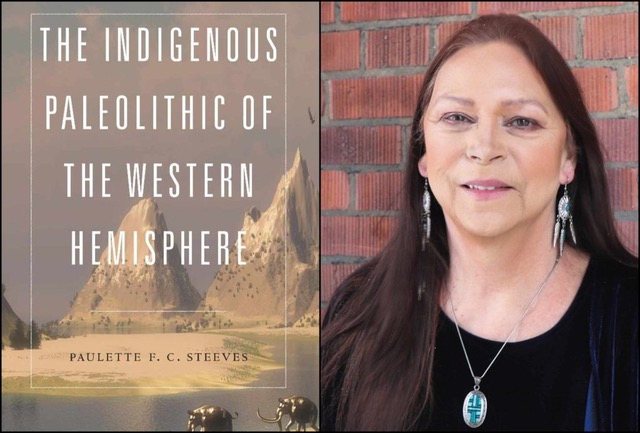
In The Indigenous Paleolithic of the Western Hemisphere, Paulette Steeves (Cree-Métis) dismantles the prevailing archaeologic story of the time and manner in which the Americas were inhabited by humans. In this story one people, the “Clovis” people, spread across North America around 12,000 years ago, the earliest time possible for people to have arrived. Archeologists who find evidence of earlier humans and offer other stories have been rejected by their colleagues. Steeves asks why the field of archeology is so set on the Clovis story, blocking academics who offer any competing evidence.
The answers are not complicated, as there is a well-documented, long-standing, and violent history of colonialism that dehumanized Indigenous people, relegating them to New Worlds of cultural infancy dominated by foreign Old World empires. (Steeves, pg. 175)
Dating sites can be controversial, and as someone who knows nothing of archeology, I appreciated her discussion of tools and methods used to date the sites older than 12,000 ago. In addition, she talks about how rock art, petroglyphs, and oral histories can help. For example, she shows how oral accounts of large birds correspond to a large prehistoric bird whose bones were found in the same area as the stories. Indigenous oral traditions have been shown to corroborate the geological, paleontological, and archeological records of specific areas and events. (Steeves, pg 10) Indigenous scholars are challenging archeological knowledge production. Steeves coins the term “pyroepistemology” based on the traditional use of fire to clear the land and allow sunlight to bring new life to the earth. Pyroepistemology clears the “academic landscape of discussions that misinform worldviews and fuel racism. Such literary renewal clears the way for healthy growth in academic fields of thought and centers of knowledge production.” (Steeves, pg 20)
Healthy growth in archeology is expanding the time frame for humans in the Americas into the paleolithic. “Paleolithic” refers to the last geologic age, 2.58 million to 11,700 years ago. Although it is unlikely that migrations into North America occurred between 24,000 and 11,000 years ago (the last great ice age) geologic and environmental evidence shows that two-legged and four-legged mammals could have migrated across land prior to 25,000 years ago, for most of the last 100,000 years, and for the greater part of the last 65 million years. Steeves presents many archeologic sites that date back before 24,000 years, including one in Southern California dated to 130,700 years ago, and others in the Southwest that may be 200,000 years old and older. I found reading of the ancient sites of North America exciting. We learn about cave paintings in Europe and have stories about early European ancestors as if these were the only people on Earth at the time. I would love to have picture books and stories about the early ancestors of Indigenous people of the Americas.
https://college.unc.edu/2024/05/bookmark-this-duval
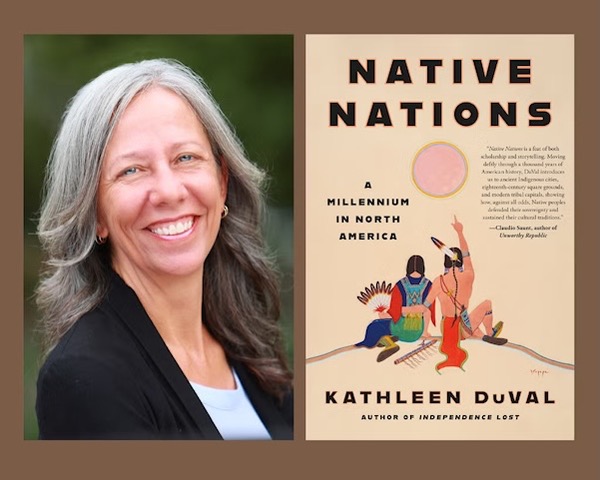
Not only has Western academia resisted evidence of early human habitation in the US, it has hidden more recent histories of Indigenous civilizations prior to European contact. In Native Nations: A Millennium in North America, Kathleen DuVal answers a question I’ve held for years: what was going on in North America before Europeans entered the scene. First, she establishes that agriculture began in central Mexico and South America about 10,000 years ago, the same time as it emerged in Mesopotamia. Agriculture then gradually spread throughout the Americas. Similar to what was happening in the rest of the world, North American people established continent-wide trade networks, built cities, and developed many diverse cultures.
DuVal’s discussion of cities especially challenged my old learnings. Cities arose around the world starting in the 11th century and large cities comparable to those of Europe grew up in North America as well. She discusses Cahokia in Illinois, Moundville in Alabama, and the Huhugam cities in the Sonoran dessert. These three civilizations built numerous pyramids, up to six stories high, long mounds on which ritual buildings stood, and large mud-built castles and ceremonial grounds. The populations grew and much labor was required to construct these imposing edifices. To accomplish this, all three cities developed hierarchical systems with increased inequality, although only at Cahokia is there evidence of forced labor and internal violence. These three complex and highly structured civilizations, encompassing tens of thousands of citizens, utilizing thousands of acres of irrigated farmlands, and on a par with similar cities of the time around the globe, existed for at least a thousand years in what is now the United States. I learned nothing about them, even as I studied the fertile crescent in middle school with its early cities and rise of agriculture.
With changing climate and increased population, Cahokia, Moundville, and the Hugugam complex of cities experienced stresses that ultimately led to their dissolution by 1400. DuVal describes how people, dissatisfied with the centralized, hierarchical nature of their cities, left and began to recreate themselves in decentralized, diversified communities based on reciprocity, evolving new politics, religions, and methods of war and diplomacy. In Europe, DuVal explains, the same stresses of changing climate and increasing numbers of people led to more centralization under the rule of hereditary monarchs.
The height of the great cities of Cahokia, Moundville, and the Huhugam can be seen as a golden age, but their descendants came to see it as a misguided era. The replacement of hierarchy with diversified economies, decentralized power structures, democratized religion, art, and war, diplomacy expressed in beads, pipes, arbors, and ceremonies would look to seventeenth-century Europeans like evidence that Indians were and always had been primitive. (DuVal, pg 71)
European explorers and colonists who witnessed the highly-successful food growing and distribution networks of Native people, the egalitarian social structures of villages, and the effective, wide-spread communication and trade systems, were somehow incapable of really seeing what was there, seeing only that it was different from their own familiar world. Even when they encountered the towering, impressive remains of the ancient cities, they didn’t believe they were created by the people currently inhabiting North America.
They persuaded themselves that the smaller-scale polities they observed north of the Aztecs—“tribes” and “bands,” as anthropologists would later call them—were simply backward, the only kind of civilization that Indians had ever had, perhaps the only kind they were capable of. (DuVal, pg 73)
In comparison, DuVal notes that Native Americans who visited European cities or even colonial towns were shocked at the inequality and lack of freedom. I soaked up DuVal’s carefully researched, detailed discussion of the development of the complex North American civilizations existing by 1500s, ones that sounded highly superior to what we have here in the US today.
DuVal describes how after Europeans enter the picture, the Indigenous people continued their lives and maintained their own interests in economic, political, and military interactions with European colonizers, traders, and explorers. Always, the intention of the colonizers has been to take land and create European systems of governance and European methods of living on the land. Ultimately, the Native nations were severely challenged and, at times, nearly destroyed. Today members of these nations are still entangled in that colonizing legacy as well as the on-going efforts of the U.S. government to assimilate or eliminate Native people.
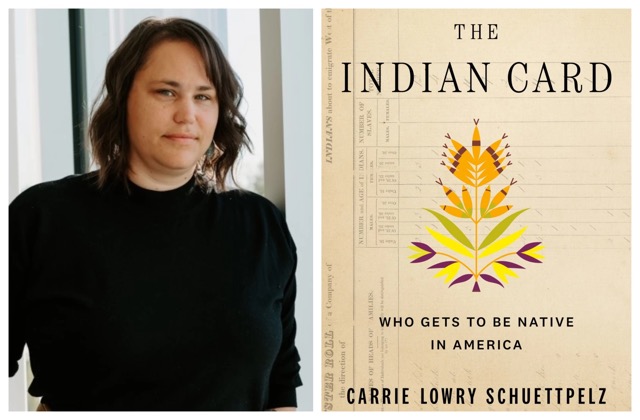
Carrie Lowry Shuettpelz grew up in Iowa, far from her Lumbee people’s homeland in North Carolina. One of her early memories is the arrival of her tribal enrollment card, which her mother allowed her to hold and look at only after washing her hands. In The Indian Card: Who Gets to be Native in America, Shuettpelz writes of growing up knowing she was Lumbee yet being with Lumbee people and culture only during family trips to North Carolina. By the time she reaches college, her personal questions around identity and belonging spark an academic focus that evolves into a deep research project, culminating in The Indian Card.
For 250 years, the United States government has imposed policies with stated intentions of terminating, or protecting, or assimilating the Indigenous people of what is now the US. During early settlement and colonization, colonizers vacillated between attempts at living together peacefully and driving the Natives they encountered away. Additionally, in the course of time, the constant pressure on Indigenous peoples to dismantle traditional, cultural ways of living forced them make changes to those traditional ways in the interest of survival. Today the 574 Federally recognized tribal nations utilize many different methods of structuring their tribal governments and defining who is a member of the tribe. In exploring “Who gets to be Native in America,” Shuettpelz shares interviews with Indigenous people wrestling with their own Native identity alongside her research into dusty documents detailing the myriad ways the US government took lands, cheated folks out of treaty money, and dismantled their traditional, cultural ways of living. Those actions by the U.S. government led to the struggles Indigenous people face today around identity and belonging.
For example, she has an entire chapter on “Membership,” another on “Counting” and one on “Payment.” After making treaties that promised monetary payments or land allotments to a tribe, the Federal government used rules to limit the “members” entitled to funds and also denied some “members” compensation. For example, in 1832 a treaty with the Creeks promised to allot land to male heads of household (traditionally Creeks were matrilineal and also didn’t hold individual title to land), so a crew was sent to make a census. But how to define qualified heads of household when Creek men often had more than one wife, where enslaved Africans lived among them, when Native women may marry white men?
The answers denied allotments to female-headed households, those without families, and those deemed enemies of the US. White men married to native women could receive allotments. Instances of marriage and then abandonment after receiving title to the land were rampant. (pg 89) With this, as with many other examples in the book, the intent was to deny as much land as possible from falling into Indigenous hands while, in the process, imposing a European way of organizing the people and their relationship to land. These old census documents, called rolls, are often used today to determine who has ancestry in a given tribe.
To determine who qualified to be counted and entered into the rolls, the US government introduced the idea of blood quantum, a method of determining eligibility through ancestry such that someone might be “only” one-quarter, for instance, Creek even though they lived in Creek community and were fully, culturally Creek. Today blood quantum requirements have worked their way into many tribes’ enrollment process. And into personal struggles with identity.
Despite knowing, rationally, that identity can’t be measured in fractions; that the federal project has long been to count Indians only in order to someday assimilate and eliminate us—hell, despite belonging to a tribe that doesn’t use blood quantum for its enrollment process—I have for a long time thought of myself as one-quarter Lumbee. (Shuettpelz, pg. 147)
Shuettpelz goes on to discuss the Indian Reorganization Act (1932) that forced tribes to adopt certain forms of government and membership rules. This is followed by the Termination era where the Federal government revoked federal recognition of many tribes, terminating benefits and the distinct relationship the government has with tribes. Her research shows how tribes were selected for termination in a pattern that indicated forced assimilation was at the heart of the policy changes. Further efforts to force assimilation followed with the era of relocation where many tribal members were encouraged, through financial payouts and promises, to move to urban centers. By 1970, for the first time ever, more Native people lived in cities than rurally.
The Indian Card, details the unrelenting pressure European colonists and their government have directed toward killing the Indigenous inhabitants of the U.S. and destroying Indigenous cultures. Although so far these efforts have failed, the fall-out for Indigenous peoples is severe and on-going, and has particular impact on defining tribal enrollment, resulting in a situation where many Indigenous people cannot enroll in their tribe.
For better or worse, Tribal membership and enrollment, lists and rolls, Native identity and belonging—all have become wrapped up in one another in a tangled ball of yarn. There are those, like my friend Lee, who claim that an enrollment card doesn’t change the way they feel about themselves or their inherent sense of belonging. But for a lot of people, it does and it will. (Shuettpelz, pg 216)
The Indigenous Paleolithic of the Western Hemisphere, Native Nations, and The Indian Card combined offer a continuous narrative of Indigenous people in North America from 200,000 years ago up to today. These three books stood out to me for the depth of research, the clear presentation of historical facts, and the personal voices of the authors woven in. I took away a reinforced belief that the Europeans who came to North America have personally and through the institutions they created, consistently and intentionally done everything they could think of to remove the Indigenous people from this land. Very few Europeans and, later, European-Americans have resisted this force of colonization or even allowed themselves to see it. These books also gave me a beautiful story of possible ancient human habitation, harmonious ways of living in community in relationship with the land, and fierce adherence to those ways in the face of on-going adversity.
The Indigenous Paleolithic of the Western Hemisphere by Paulette F. C. Steeves
Native Nations: A Millennium in NorthAmerica by Kathleen DuVal
The Indian Card: Who Gets to Be Native in America by Carrie Lowry Shuettpelz
The two books I didn’t write about. Both recommended:
Nothing More of This Land: Community, Power, and the Search for Indigenous Identity by Joseph Lee https://birchbarkbooks.com/products/nothing-more-of-this-land
The Water Remembers: My Indigenous Family’s Fight to Save a River and a Way of Life by Amy Bowers Cordalis https://birchbarkbooks.com/products/the-water-remembers
Written by Judy Helfand
Leave a Reply