
Loving Latina Women by Dinah Bachrach
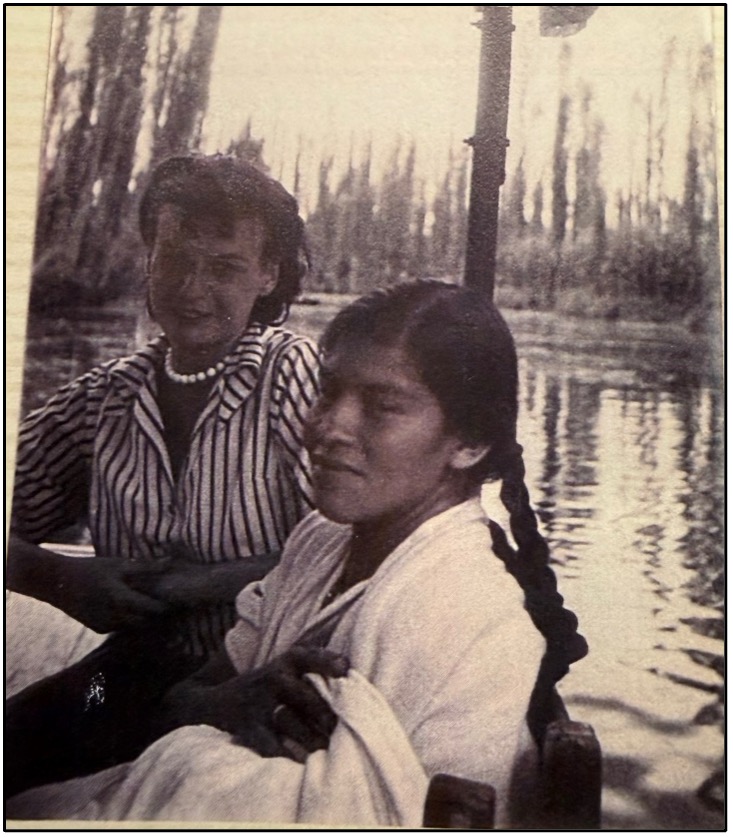
(Albertina Grande and a family friend)
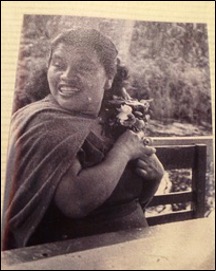
(Francisca)
I am four. The beautiful yarns are being woven into my braids and I love their colors: magenta and orange and purple-blue…how perfectly they look together! And how special and lovely I am becoming as Albertina Grande, with her always moving sinewy-brown hands, weaves them in while talking to me in her melodious Spanish. I picture her hands as she makes tortillas for us and how I love watching her and envy her skill, turning a little masa dough ball into a flat thin circle, round and round so quickly. My mouth waters, knowing soon they’ll be fried and warm and crisp, so delicious to eat. I enjoy them alongside my brother Tonio, her daughter Albertina Chica, and Francisca’s son Pablo. We are a little foursome who roam the streets of Avenue Toluca sometimes with our centavos, listening for the jingle of the cart with its candy to buy from an ancient leather-skinned man.
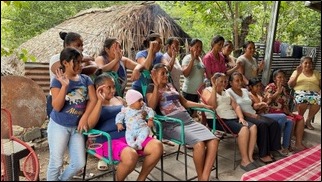
Now I am 77 and three quarters of a century later, I find myself visiting women’s groups in isolated rural villages of Guatemala, receiving their customary handshakes, grabbing one another’s forearms, and hugs and smiles from women whose warmth remind me of Albertina Grande.
In the early 50s my Communist parents escaped Berkeley and the McCarthy witch hunts, taking my brother and me to live in Mexico City. We lived like wealthy people for three years on my Dad’s G.I. bill, a white privilege as black people were denied that benefit. We could afford two live-in servants, sisters, and had space enough for them and their two kids. We moved back to the US when I was five but my earliest memories were of their loving care and culture. I lived in a divided world: my parents with their world of connection, and the profound poverty around us. Both left an indelible impression on me and my brother. That sense of familiarity, trust and warmth toward brown-skinned people remains and led to my easy choice to adopt my newborn daughter from Brazil in 1988.
Though I grew up in the US feeling outside mainstream culture with my parents’ rebellious anti-establishment and anti-racist values and simpler lifestyles, I now recognize the imbedded white privilege that led to their abilities to have professions. They were college-educated and eventually became homeowners and built equity. And I followed their path also, which includes living in a pretty segregated white world. I have spent my life seeking ways to have some connections with people of color, and to other marginalized people. Some of those connections have been as a therapist, some as an activist, some as a donor. STILL, I sorrow and rage at the injustices and suffering of economic inequity, and ache with a longing for what I once had in those three years of a multi-cultural daily life.
I had the enormous privilege in every sense of that word to visit women’s groups in Guatemala because of a wonderful 50+ year-old Quaker organization called Right Sharing of World Resources. My beloved partner serves on their board and will soon be clerk (like president) of it. They offer grants to women’s groups in Sierra Leone, India, Kenya and Guatemala.
Local country coordinators offer training in skills needed to succeed in a small business venture. Prior to receiving a grant from the organization, a group of about 15 women forms. They draw up their own “constitution” ensuring group commitment and accountability. From their membership they choose a president, secretary and treasurer to lead the group. The $6000 grant the group receives is divided to become loans to each woman to start or expand a small business. At their monthly meetings each woman pays a small amount into her own personal savings account, a small amount into the group’s emergency fund, and repays a portion of their loan with interest tied to the country’s inflation rate. They have a year to repay their loan, and then they may choose to take out another loan to expand their business further. New women can join the group as others launch on their own.
We saw this group process in action at their meetings and visited several of their businesses, witnessing their great pride as they told us about their businesses and the transformation of their lives through their work. One had bought a motor to make masa from corn; another bought that masa and made tortillas to sell on a gas-powered griddle; one was a tailor and embroiderer whose other family members made clothes; another had expanded their flock of chickens and goats to include a cow; one baked bread in a big clay beehive-shaped oven; another made tamales to sell.
In a country where women rarely trust one another, where misogyny is rampant, it is heartening to see women help one another through hard times, and improve the lives of their children and community. Their husbands become supportive as their family lives become more secure. Some of the groups in India, where this organization first started women’s groups 50 years ago, have been serving generations of women in the same family.
I think back to my beloved caregivers, the sisters Albertina Grande and Francisca, whose husbands were long-gone as they raised their kids, who got three years of security working for my parents. But when we left, they returned to a life of city poverty, with nothing to take away. My parents divorced when we returned from Mexico, but when I was 12, my father and stepmother, brother and I visited the sisters. They went to great lengths to make my dad his favorite dish of chicken mole. The four of us kids were shy with each other, we couldn’t talk as my brother and I had forgotten our Spanish, so my parents treated us to a trip to the big city park where we rented bicycles, which they were thrilled and clumsy on. I was shocked at how and where they lived, and how little they had. We had had our own bikes for years!
As I write I feel such sadness. I see how my parents, so liberal and well-intentioned, unconsciously exploited them in a colonial fashion when they were needed and then moved on with their own privileged lives. I wish Albertina Grande and Francisca could have been supported and empowered by the kind of women’s groups we got to witness.
And I am aware with much pain and horror that many families in Guatemala escape the grinding poverty and violence and corruption there for a better life in the US only to now be hunted and brutalized and deported by ICE back to a dangerous situation. To be brown-skinned these days in the US, even as a citizen, is to live in constant fear. Although I am part of a Rapid Response Team to document such deportations, I ache for all the Albertina Grandes I cannot protect. I wish I could offer them the safety and welcome the Guatemalan women offered me, a white-skinned woman in their country.
Leave a Reply