
How Will We Respond to Authoritarianism in the U.S.?
by Wendy Millstine
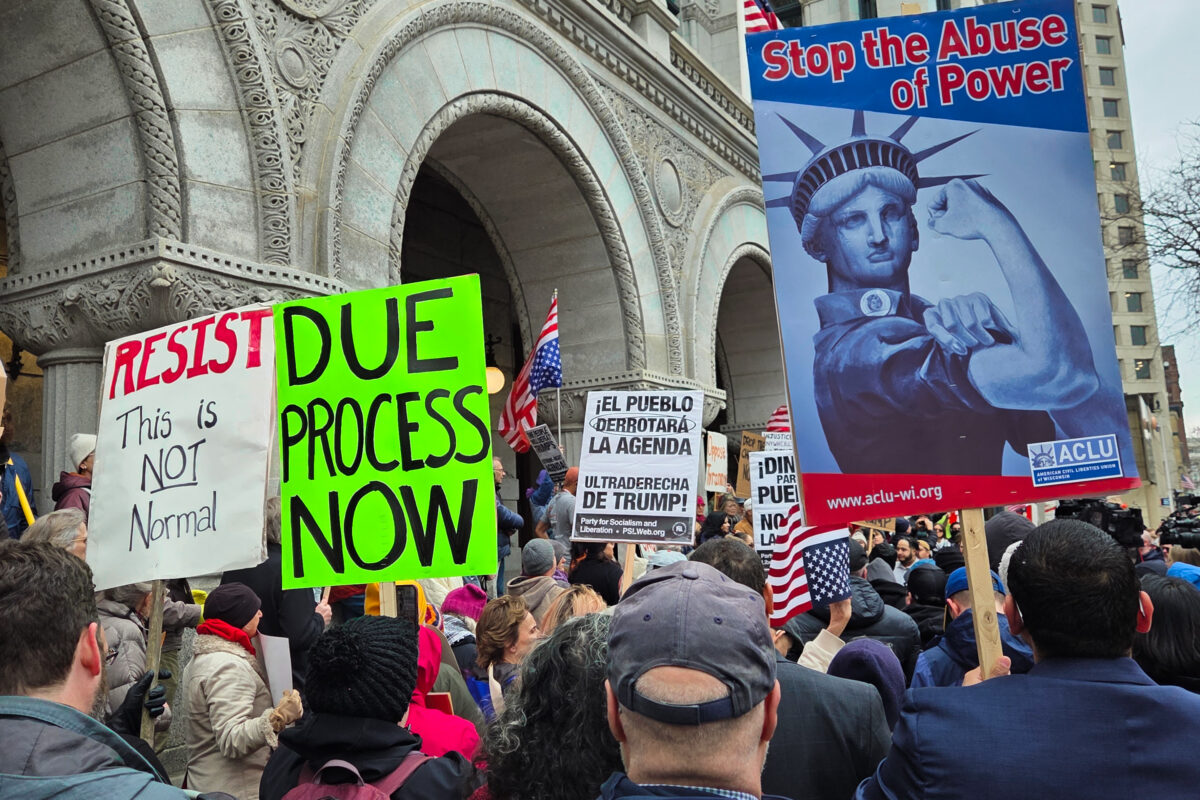
(Source: ACLU of Wisconsin)
Let’s start with defining authoritarianism. Authoritarianism is a system where one leader or a small group holds most of the power and expects people to obey without question. Individual freedoms are limited, and those who disagree are often silenced or punished. Instead of being accountable to the public or a constitution, leaders stay in control through media control, laws that protect them, and the use of force—prioritizing order and control over personal freedom and democratic choice.
A dear friend recommended a Brazilian film to me titled, I’m Still Here (Ainda Estou Aqui). It is not just a story—it’s a dire warning. Based on real events, it tells the harrowing story of Eunice Paiva, whose husband, Rubens Paiva, a congressman and pro-democracy activist, was kidnapped, tortured, and disappeared by Brazil’s military dictatorship in the 1970s. For decades, Eunice searched for the truth, defying a system built on fear and silence. Her story is a reminder that authoritarianism doesn’t arrive all at once; it creeps in slowly, cloaked in promises of “law and order,” until one day, people disappear, voices go quiet, and fear replaces freedom.
I’m Still Here resonates as more than a distant historical tragedy. It’s a mirror held up to our own moment. Around the world, democratic norms are being tested, truth is under attack, and the machinery of state violence—armed agents, secret detentions, unchecked executive power—continues to threaten vulnerable people. The images in I’m Still Here—unidentified agents, scapegoating dissidents, families left without answers—disturb us because they feel eerily familiar.
Currently in our country, we are witnessing Homeland Security, ICE and Border Patrol detain people without transparency, separate families, and deport individuals without due process. We’ve seen federal agents in unmarked uniforms kidnap protesters off the streets. We are witnessing political leaders enflame fear of immigrants and normalize cruelty as policy. These are not the hallmarks of a free society—they are blatant signs of authoritarian drift.
The power of I’m Still Here lies in its human core: a mother who refuses to forget, who resists erasure by determinedly insisting on truth. Eunice’s courage exposes the lie at the heart of every dictatorship—that obedience is safety, and silence is peace. Her persistence reminds us that democracy depends not only on laws and institutions, but on people willing to defend one another when those systems fail.
We, too, must decide who we will be as our government turns its power on the powerless. Do we look away when immigrants are rounded up in our communities? Will we stay silent when dissenters are branded as enemies? Or will we stand together, declaring—as Eunice did—I’m still here?
Now more than ever, America must recommit to being a nation of sanctuary—safe for all people, regardless of immigration status, religion, race, gender, or political belief. Sanctuary is not a radical idea; it’s a moral one. It means refusing to cooperate with injustice, protecting due process, and ensuring that no one is “disappeared” under the cover of bureaucracy or white nationalism. It means remembering that freedom is only real when it belongs to everyone.
I’m Still Here is not just a film about Brazil’s past. It is a warning about our possible future—and a call to act before it’s too late. We cannot let fear or apathy turn us into collaborators with cruelty. The lesson is clear: authoritarianism thrives when ordinary people stop defending each other. Democracy survives only when we refuse to disappear.
Please note: This film should come with a trigger warning. At times, it’s extremely upsetting and frightening. I recommend that you watch it with a friend or family member. But it is also a message of female heroism for truth.
Here’s a trailer: https://www.youtube.com/watch?v=gDunV808Yf4. You can watch this on Netflix.
Written by Wendy Millstine
Leave a Reply